KGCPA

Exploring the Boundaries of Psychology
Religious bigotry mental wellnes… 202605061739

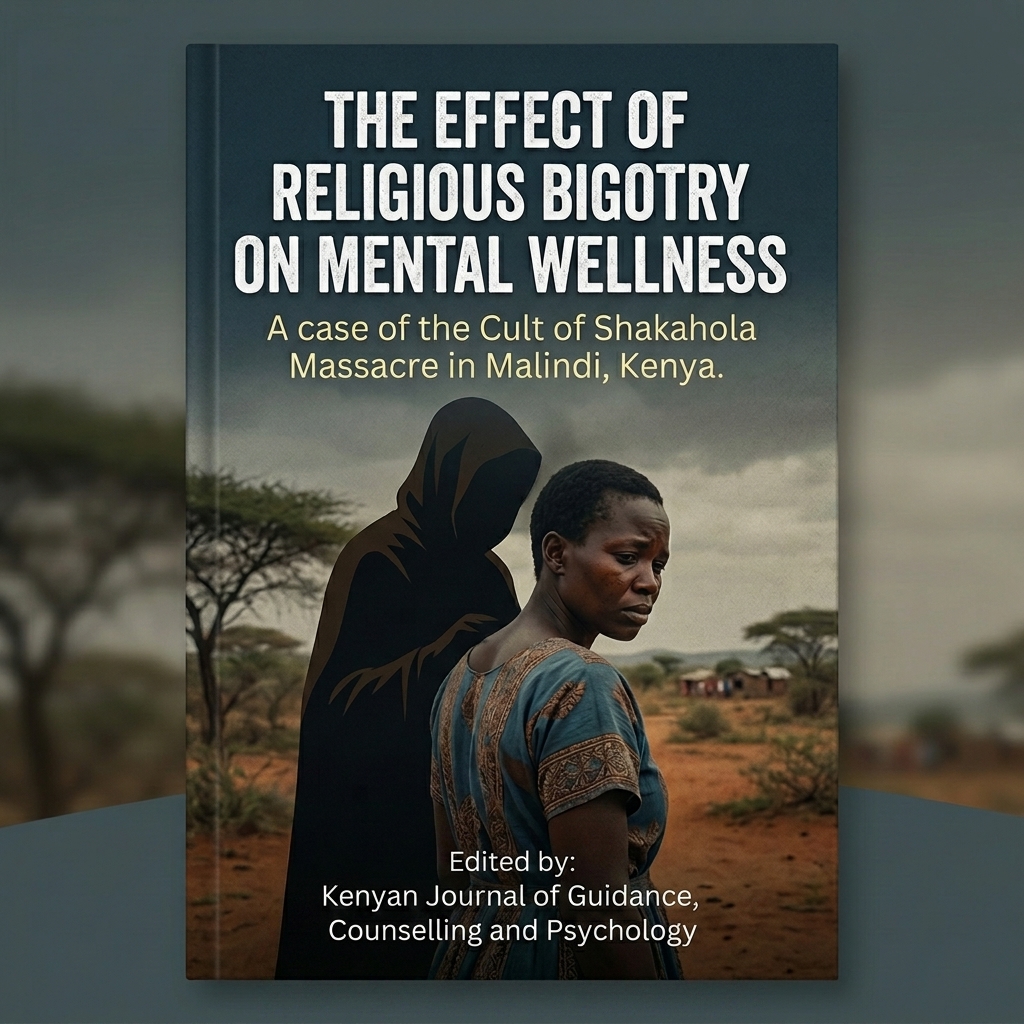
The Effect of Religious Bigotry on Mental Wellness: A Case of the Cult of Shakahola Massacre in Malindi, Kenya

Volume 10 | Number 1 | April 2026

_
The conventions of religious experience(s) have been known to provide moral, spiritual, and mental support to adherents of specific faith communities. The rapid growth in religious pluralism and diversity in the digital age poses mental challenges to the populace through a bombardment of competing and conflicting religious ideas in the inter and intra-religious domain. Specifically, the unchecked proliferation of faith groups opens space for extremism, bigotry, and manipulation of the masses by a religious idea that rides on the existential needs of humanity. In the milieu of indoctrination or radicalization a massacre in Malindi, Kenya, perpetrated by the Good News International Church under a ‘Pastor’ Paul Nthenge Mackenzie caused the deaths of at least 436 persons including children.

Pexels pixabay 247314

An Assessment of Mental Health Issues in the Era of Islamic Radicalization: A Case of Muslim Youth in Isiolo County, Kenya

Volume 9 (2021)

_
The discussion on mental health issues has yet to consider the role played by religious ideology that leads to radicalization. Apart from the proven narrative that people with mental disturbances do not become prime candidates for recruitment into religious terrorism, the mental distress, anxiety, depression and other personality or relational problems leading to extremism requires probing within the general area of mental health issues. The effect of radicalization on mental states was measured by conducting qualitative and quantitative research using mainly the tool of a questionnaire for data collection which was administered on youths from selected primary and secondary youths in Isiolo County.

Pexels jairo david arboleda 1432238

African Ethnocultural Counseling: Research, Theory and Practice

Volume 7 ( 2017)

Ndung’u J. B. Ikenye
St. Paul’s University

_
This paper presents a clinical research in ethnocultural counseling, answering the Question: What is the role of positive ethnicity and culture in counseling within African contexts. The focus of the study is positive ethnic identity and positive cultural values, and their contribution African counseling theory and practice. The thesis of the paper is that African ethnocultural counseling is a necessity in theory and practice, and in the creation of a genuine counselor-client relationship which focuses in sympathy, empathy and interpathy. The study used the Case Study method with an ethnographic focus (observation and participation of counselor) and clinical design, where the counselor’s client’s data is collected, analyzed, discussed and interpreted from two cases. The study uses clinical psychology, positive ethnic and cultural eyes in theory and practice of ethnocultural counseling. The study found that positive ethnic identity and positive cultural values are central to the understanding of Axis I clinical problems that result to suffering of persons; of Axis II in personality disorders and marital functioning; and Axis V Global Functioning of persons. The study also found that goals of counseling and implementation of counseling systems are better done when positive culture and ethnicity are considered and aligned as contexts for healing and optimal living. The study also found that, positive ethnicity and culture are connected to success and failure client-counselor relationship. The study concluded that African ethnocultural theory and practice is a necessity in cross-ethnic and cross-cultural counseling. The study recommends that African counselors be sensitized to cross-ethnic and cross-cultural dynamics in their training, practicum and in developing competence

Pexels bruno massao 2095597

Portent and Preventive Factors for Trauma among Journalists in Kenya

Volume 6 (2016)

Scholastic M. Adeli, Francisca Mbutitia & Carolyne Chakua
_
Journalists frequently bear witness to human suffering however, little is known regarding the impact of such exposure on the well-being of journalists. The purpose of this study was to establish the portent and preventive factors of trauma among journalists. This was a qualitative study in nature and it adopted a descriptive design. The objectives of this study were to establish the types of events journalists are exposed to, the effects of covering such events, the symptoms that place journalists at risk for psychological distress and possible solutions. Using convenience sampling therefore, a total of 52 journalists attending a workshop participated in this study. Included in the sample were journalists from five major media houses in Kenya. A questionnaire on trauma incidences that journalists have so far covered and professional self-care was the main instrument for data collection. Percentages, frequencies and means aided in the analysis of descriptive statistics. Results revealed that most (97%) journalists suffer from Secondary or Vicarious Trauma as a result of seeing, witnessing, intervening, interviewing and listening to trauma experiences by victims. On the contrary, 62% of the respondents felt that it is a normal thing for journalists to suffer from trauma as a consequence of their work because the coverage of extreme human distress is a fundamental part of a journalist. The common traumatic events that journalists covered were alcohol and drug related deaths (87%) and police harassment (83%) though 79% of the journalists did not know that by covering traumatic events, they in turn can be traumatized. More than half (67%) reported having psychological and health related problems as a result of their work with 72% using journaling as a coping strategy. From the results it is concluded that though trauma affects journalists its psychological impact is overlooked by the journalists because they believe that a tough journalist is one who will report on human destruction and misery and expect the people who read or hear their stories to be affected by what happens but they don’t expect to be affected. Based on these results therefore, it is recommended that newsrooms need to develop a policy on reporting crises, such as rotating reporters to avoid continuous exposure to traumatic events and having a programmed psychological support system for those who cover traumatic events.
Pexels element digital 1550337

Effects of the 2007 Post-Election Violence on Attitude Formation among Children in Uasin Gishu County, Kenya

Volume 5 (2015)

Dinah S. Were
Samuel N. Maragia
Masinde Muliro University of Science & Technology,
_
In recent past years, various forms of violence have erupted soon after elections in many African states and caused a death and a lot of damage on property. Children in warring areas are affected mentally, physically, socially and emotionally from the experiences during such violence. Positive and negative attitudes may be formed from experiences children go through early in life. The study carried out in Uasin Gishu County on the forms of violence experienced during the 2007 PEV and attitudes formed by children. The concern to carry out the study came about after realizing that children psychological needs were not adequately addressed after the 2007 post-election violence (PEV). The study adopted descriptive survey design to collect data from 288 children who were sampled for the study in Uasin Gishu County –Kenya. There were questionnaires for teachers, interview guides for key informants (chiefs, DOs, and counsellors. Focus Group Discussions were done and observation guides employed to observe conditions at the IDPs. Children did essays and drawings on the experiences they had during the violence. Snowball sampling technique, stratified and purposive sampling were employed in the study. Descriptive and inferential statistics were used to analyze data collected. From the findings, children experienced various forms of violence during the 2007 PEV in the County from sexual violence, going without food and water to physical bodily harm. From their experiences children developed negative attitudes such as hatred towards other people, towards political elections. They developed fear towards security men, their neighbours and towards elections. Some children have developed inferiority complexes about their tribe and because of living in IDP camps. Mitigation strategies were not adequate due to inadequate funds and personnel hence leaving most children vulnerable. Recommendations were that the government should resettle all Internally Displaced Persons as soon as possible and counsel children and families affected by the violence.
Pexels collis 3031391

Relationship between Retirement and Socio-Economic and Psychological Status of Former Public Servants in Vihiga County, Kenya

Volume 4 (2014)

C. M Mbaruku*, A. M Sindabi and B. E. E Omulema
Egerton University,

_
Pension is paid to former workers to help them transit safely into retirement. In spite of this, a number of these retirees in Vihiga County have difficulties in maintaining their responsibilities such as paying for their medical care, paying school fees for their children or even sustaining their families. As a result of such difficulties encountered upon retirement, several measures have been introduced at different times to mitigate the situation. For instance, retirement age was adjusted upwards or completely done away with, while new forms of pension have been introduced. Despite the shift from one step to another, retirees in Vihiga have continued to face same challenges. This study therefore, intended to determine the relationship between retirement and socio-economic and psychological status of the retirees. The study was guided jointly by three theories namely, social disengagement theory, activity theory and continuity theory. A descriptive ex-post facto causal comparative survey research design was used to conduct the research study in Vihiga County. The accessible population for the study was 958 former public servants. Proportionate stratified random sampling technique was used to select a total sample of 198 participants. A questionnaire and focused group discussion schedule were used to collect data. Mathematical techniques comprising of percentiles, pie chart, bar-graphs and inferential statistics comprising of chi square and t test with the help of SPSS version 17 were used to analyze the data. The findings of the study revealed that there was a relationship between retirement and socioeconomic and psychological status of retirees. However the results did not show any significant difference in the relationship between retirement and socioeconomic and psychological status of retirees based on gender. Thus the study recommended that the current retirement program be improved by incorporating guidance and counseling services so as to safeguard retirees against socioeconomic hardships and against psychological problems.
Pexels pixabay 247314

Prevalence of Depression among Medical Students in Kenyan Universities

Volume 3 (2013)

Irene Chesire1*, Hezborn M. N. Kodero2 and Simiyu M. Mulamba3
1College of Health Sciences, Moi University, P.O. Box 4606-30100, Eldoret
2School of Education, Rongo University College, P.O. Box 103-40404, Rongo
3School of Education, Moi University, P.O. Box 3900-30100, Eldoret
*Corresponding author e-mail: chesireij@hotmail.com

_
The study investigated the prevalence of depression among university medical students in Kenya. The participants comprised 312 undergraduate medical students from two public universities in the country selected using stratified random sampling. Of these participants, 154 were males and 158 females. This was a quantitative research adopting a causal-comparative and a cross sectional survey designs. The Beck Depression Inventory – II (BDI-II), the Multidimensional Scale of Perceived Social Support and a Biographical form were the research instruments of data collection. Analyses were performed using descriptive and inferential statistics (t-test and Pearson r). Results revealed that 27.2% of medical students had depressive symptoms (BDI-II > 14). No significant relationship was found between gender and depression level (p = .298). However, there was a significant inverse relationship between social support and depression level among medical students (p = .000). There is a high prevalence of depression among medical students, and social support is a moderating factor. The study provides useful information for action, to medical education, counselling and medical personnel in the universities.ating guidance and counseling services so as to safeguard retirees against socioeconomic hardships and against psychological problems.
Pexels christina morillo 1181516

Influence of peer counselling on school adjustment of secondary school students

Volume (2012)

Margaret A. Disiye* and Jenniffer K. Munyua Department of Educational Psychology, Moi University,

P. O. Box 3900, Eldoret, Kenya *Corresponding author e-mail: mdisiye@yahoo.com

_
The study investigated the influence of peer counselling on school adjustment of secondary school students and problems that led students to seek peer counselling. The research population was Form 2 and 3 students in 24 secondary schools in Eldoret municipality, Kenya. The sample comprised of 447 (193 female and 254 male) participants drawn from 8 co-educational secondary schools. Stratified and simple random sampling techniques were employed to select 8 mixed day schools and participants respectively. The study used causal-comparative and cross sectional survey research designs. A biographical form and questionnaire were used in data collection. The questionnaire measured participants’ level of school adjustment while the biographical form was used to find the problems that led students to seek peer counselling. The questionnaire was pilot tested before use and was found to have a reliability coefficient of r = 0.79. The findings indicated that peer counselling influences school adjustment of students, and that academic, personal, and social problems were major reasons leading students to seek peer counseling. Stakeholders in the education sector could find these findings useful in addressing school adjustment and peer counselling training needs for secondary school students.